2025 Investment Review - Resilience in the Face of Headlines
As we kick off a new year and I look in the rearview mirror, I am reminded of why investing takes discipline. A lot of our work as investment advisors is focused on assessing where markets and economies are headed. So admittedly, I have a short-term memory for a lot of the scary headlines and stories that shape the year, making this type of “year in review” exercise an important reminder of all we were able to navigate. 2025 was a year that tested investor resolve with plenty of headline-grabbing news, yet the markets demonstrated remarkable resilience, rewarding those who stayed disciplined and stuck to their long-term plans.
A Strong Year for Stocks Despite the Noise
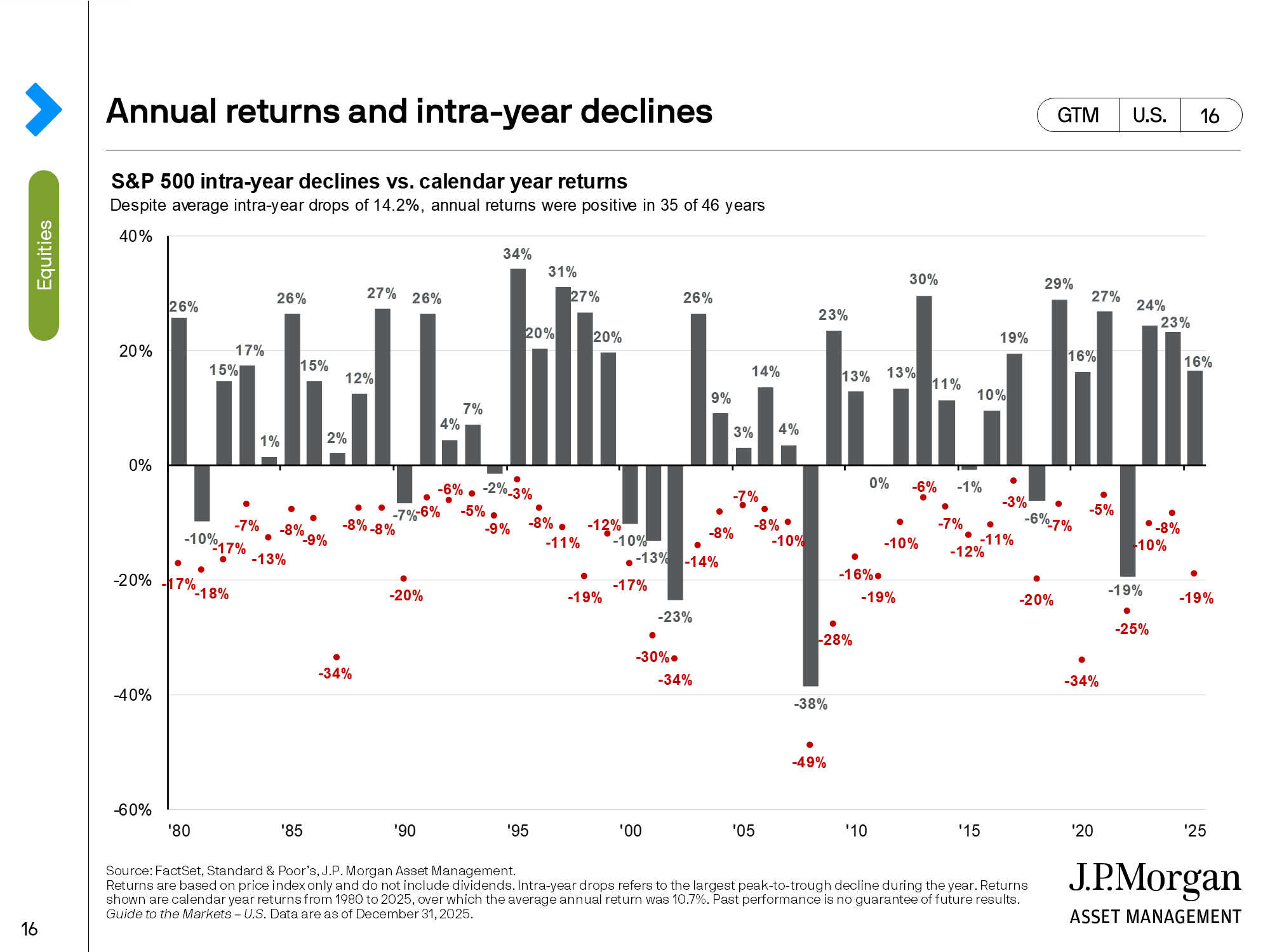
The S&P 500 delivered a solid price return of approximately 16.4% for 2025 (with total returns, including dividends of 17.9%). This marked the third consecutive year of gains exceeding 15%, a rare streak that has only occurred a handful of times since 1928. However, it wasn’t a consistent march higher. In fact, it was far from it! The chart below illustrates a timeless truth; even in strong calendar years, markets typically experience significant intra-year drawdowns. The gray bars show calendar year annual returns, while the red dots highlight peak-to-trough declines often 10-20% or more within the year. Volatility is normal, and 2025 was no exception. Sometimes I think it would be so much better for us psychologically, if we could simply flash forward to the end of the calendar year to see the result and not have to experience the rollercoaster ride of investments. But there is a popular saying in the investing world that I think drives home the point, “volatility is the price you pay for performance” and I think that applied again for 2025.
Headline Risks That Grabbed Attention
2025 was filled with scary stories that could have derailed even the most disciplined investors:
- Tariffs and Trade Policy Shocks: A sharp rise in effective tariff rates under new policies triggered lots of volatility, including a stock market correction of over 10% in early April (in a matter of a few trading days). This was on top of an initial pullback that started after hitting all-time highs in February, which led us to a total peak-to-trough downturn of roughly 19% in April. Many feared this would spark widespread inflation, disrupt supply chains, and tip the economy into recession.
- Persistent Inflation and Fewer Rate Cuts: Inflation proved stickier than the Federal Reserve expected, leading to fewer interest rate cuts than originally anticipated by investors. This kept interest rates elevated longer and fueled concerns about consumer spending and corporate profits. The Federal Reserve did ultimately cut rates in September, October and December, reducing their target interest rate policy by 0.75%.
- Cooling Labor Market: Signs of a slowing job market also added to recession worries.
- AI Bubble Fears and Overhype Concerns: There was a lot of debate about whether skyrocketing valuations in AI-related stocks (especially Big Tech) signaled a dangerous bubble reminiscent of the dot-com era. Warnings from experts about potential over-exuberance and softer future AI spending caused sharp selloffs at times, raising fears of a major correction in the tech-heavy market.
Despite these challenges, the U.S. economy proved remarkably adaptable. Growth remained steady without slipping into recession. Corporate America delivered consistent double-digit earnings growth, maintained record-high profit margins, and showed strong fundamentals. Consumers continued spending robustly, even amid tariff uncertainties and higher prices.
The result? Markets recovered from the volatility, particularly sharp in the first half, and ended the year on a high note flirting with all-time highs, yet again.
Broader Market Performance
While U.S. stocks (as measured by the S&P 500) performed well, the real standout was international and emerging markets, which surged over 30% in many cases, benefiting from a weaker U.S. dollar and regional growth dynamics.
On the fixed-income side, bonds provided welcome diversification with solid gains of around 7% for broad investment-grade indexes (the best year since 2020) as yields stabilized and provided attractive income.
2025 was the first year in a little while where it felt like diversification was truly working in favor of long-term investors and not against us.
The Key Lesson: Stay the Course
Bull markets are rarely linear, and pullbacks, even sharp ones, are part of the journey. The noise from tariffs, inflation fears, and policy shifts in 2025 could have easily prompted reactive decisions. But as we've seen time and again, markets have a way of climbing the "wall of worry." Those who remained invested and adhered to their personalized financial plans were rewarded.
As always, your portfolio is designed with your unique goals, risk tolerance, and time horizon in mind. Wishing you a prosperous and healthy New Year!
Investment Advice offered through Great ValleyAdvisor Group, a RegisteredInvestment Advisor. Great Valley Advisor Group and Haas Financial Investment Advice offered through Great Valley Advisor Group, a Registered Investment Advisor. GreatValley Advisor Group and Haas Financial Group are separate entities. This is not intended to be used as tax or legal advice. Please consult a tax or legal professional for specific information and advice. are separate entities. This is not intended to be used as tax or legal advice. Please consult a tax or legal professional for specific information and advice.